How to Choose the Best Red Light Therapy Sauna in 2026: Buyer's Guide
A red light therapy sauna costs thousands, and most buyers compare the wrong specs. Wavelength counts and heater types get buried under glossy brochures while the details that shape daily use go unmentioned. This guide fixes that gap.
You will learn what separates a clinical-proximity LED array from decorative lighting, why cedar and in-house manufacturing affect longevity, and how wavelength, EMF, and heater design interact. By the end, you will have a checklist for evaluating any red light therapy sauna in 2026, including where SaunaCloud fits.
What Is SaunaCloud? Custom Infrared Saunas With Integrated Red Light Therapy
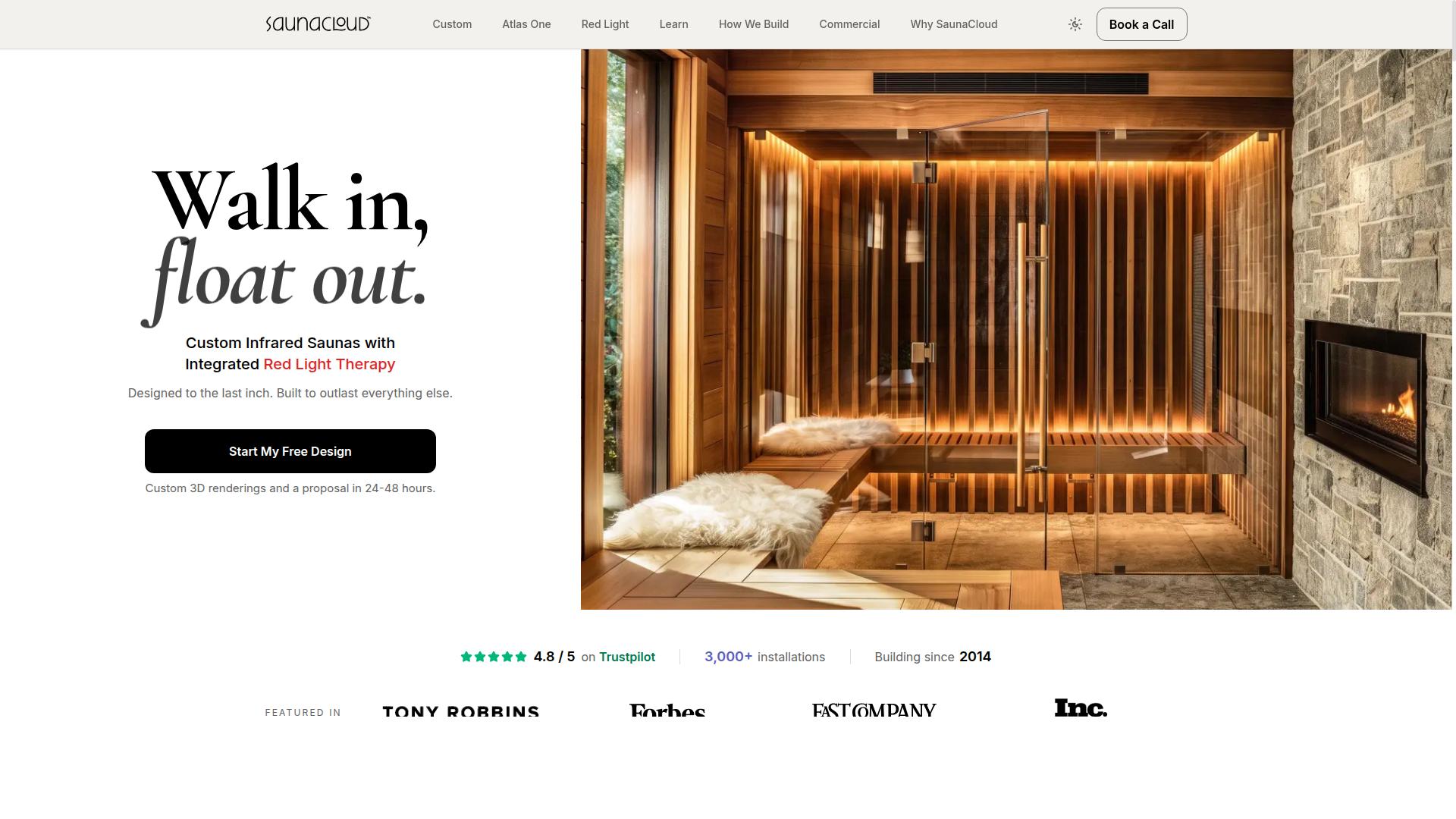
SaunaCloud is a California-based manufacturer that has been building custom infrared saunas with integrated red light therapy since 2014. The company engineers and handcrafts each sauna with clinical-proximity red light therapy built directly into the cabin.
Founded in Diamond Springs, California, SaunaCloud operates from facilities in Diamond Springs and Montreal, Quebec, and has completed more than 3,000 installations across North America. Every unit is designed, engineered, and built in-house, including VantaWave® heaters, CORE 5™ power supplies, printed circuit boards, Wi-Fi control systems, and red light therapy arrays.
For buyers comparing red light therapy saunas in 2026, that in-house approach matters. It means the light arrays and heating elements are developed together rather than assembled from mismatched parts.
Who SaunaCloud Serves: Homeowners, Clinics, and Wellness Centers
SaunaCloud's custom infrared saunas are designed for three primary customer groups: homeowners, clinics, and wellness centers. Each group has different goals, and the custom build process allows the cabin, bench configuration, and light array layout to be tailored to how the sauna will actually be used.
For homeowners, the focus is usually personal wellness. Buyers often want a red light therapy sauna for recovery after training, sleep improvement, stress reduction, and cardiovascular health. A home unit might be sized for one or two people, with a Wi-Fi control system that makes a daily session easy to fit into a routine.
For clinics, the priorities shift toward patient outcomes and throughput. A chiropractic clinic, for example, might use a sauna for post-adjustment recovery, helping patients relax muscle tissue after treatment. Pain relief is a common goal, and professional-grade equipment needs to hold up to frequent daily sessions.
Wellness centers sit between the two. They serve members who expect a polished experience, so full-body coverage and comfortable interior space can matter as much as the near-infrared and far-infrared output. Staff also need reliable controls to manage back-to-back appointments.
Across all three groups, the common thread is a custom infrared sauna built for recovery, pain relief, sleep improvement, stress reduction, and cardiovascular health. Understanding which segment you fall into is a useful first step in any 2026 buyer's guide, because it shapes decisions about seating capacity, cabin construction, and how much red light coverage you actually need.
Is SaunaCloud the Best Choice for a Red Light Therapy Sauna in 2026?
Determining whether SaunaCloud is the best choice for a red light therapy sauna in 2026 requires comparing its specifications against the key criteria that define clinical-grade photobiomodulation. The buyer's checklist below covers wavelength, irradiance, coverage, EMF exposure, and cabin construction. This section measures SaunaCloud against those same points so you can judge the fit for yourself.
The short answer is that SaunaCloud is a strong contender, particularly for buyers who want red light built into the cabin rather than added as an afterthought. Its specifications line up well with the priorities that matter most in 2026: clinical proximity, low EMF, and full-body delivery.
Here is how the brand performs on the criteria that shape this buyer's guide.
- Integrated red light therapy at clinical proximity: LED emitters are built into the benches and backrests, placing light roughly 2 to 6 inches from the body. Distance is one of the most overlooked factors in effective photobiomodulation, since irradiance drops sharply as the gap widens.
- Low EMF heating elements: VantaWave® heaters emit under 3mG of EMF, often below 0.5mG. They reach a 190°F surface temperature at a 7.9 micron peak wavelength, which sits in the far-infrared range.
- Custom sizing: Because every component is designed and manufactured in-house, cabins can be built to fit a specific space or seating capacity rather than forcing the buyer into a fixed footprint.
- In-house manufacturing: Design and production stay under one roof, which supports consistency across the heating elements, LED placement, and cabin construction.
Materials also matter for anyone comparing cedar wood against hemlock or basswood. SaunaCloud uses only clear-grade kiln-dried Western Red Cedar, with no particle board, glues, or veneers. That is a meaningful detail for a cabin you sit in for 20 to 40 minutes at a time, since lower off-gassing supports cleaner air during sessions.
Backing the hardware is a lifetime warranty and a 4.8/5 Trustpilot rating from 217 verified reviews. The company has held a BBB A+ rating since 2015 and was named Inc. Regionals Pacific #118 fastest-growing company in 2023. Its cabins are used by Tony Robbins, The Westin, Marriott, and Cavallo Point Resort, a track record that speaks to commercial-grade reliability.
A balanced assessment: SaunaCloud is not positioned as the lowest-cost option on the market, and buyers shopping purely on entry price will find cheaper cabins elsewhere. For those prioritizing integrated red light therapy at clinical proximity, ultra-low EMF, and custom sizing from an in-house manufacturer, it stands out as one of the more complete choices available in 2026.
What to Look for in a Red Light Therapy Sauna: 2026 Buyer's Checklist
A red light therapy sauna in 2026 should be evaluated on five core criteria: wavelength accuracy, irradiance at the skin, EMF emissions, build quality, and coverage area. This buyer's guide frames those criteria as a practical checklist you can apply to any infrared sauna cabin, regardless of brand or price point.
Treat the checklist as a filter, not a marketing sheet. A sauna that fails on wavelength accuracy or EMF emissions cannot be fixed later by better wood or a nicer control panel. The two subsections below walk through the specs first, then the materials and construction that determine how well those specs hold up over years of use.
Wavelengths, Clinical Proximity, and EMF: The Specs That Matter
The three specifications that most directly affect red light therapy outcomes are wavelength, irradiance at the skin, and EMF emissions. Everything else in the cabin supports these three, so confirm them before you look at anything cosmetic.
660 nm red light and 850 nm near-infrared are the two wavelengths most associated with photobiomodulation. The 660 nm band is absorbed closer to the skin surface, while 850 nm penetrates deeper into tissue. A quality LED panel should list these wavelengths explicitly rather than describing them vaguely as "red light."
Irradiance, also called power density, is measured in mW/cm². Experts generally recommend a minimum of 10 mW/cm² at the skin for meaningful treatment. That number only holds when you sit close to the panel, so clinical proximity of roughly 2 to 6 inches matters as much as the panel's rated output.
EMF exposure is the spec buyers most often overlook. Focus on ELF (extremely low frequency) emissions from the heater and electronics, since these are the fields most commonly measured in sauna cabins. Look for heaters rated under 3 mG, ideally under 1 mG, at your normal seating position.
A simple pre-purchase checklist:
- Confirm wavelength: verify 660 nm and 850 nm are stated clearly on the spec sheet.
- Measure irradiance: check power density at the seat where you will actually sit, not at the panel face.
- Verify EMF: ask for gauss meter readings, or measure the cabin yourself with a handheld meter before committing.
Adjustable intensity and pulse mode are useful extras, but they cannot compensate for weak output or high EMF. Get the core three right first.
Materials and Build Quality: Why Cedar and In-House Manufacturing Matter
The materials and construction of a sauna cabin determine its durability, energy efficiency, and off-gassing potential. Wood choice is the first decision, and each species carries trade-offs.
Cedar wood offers natural rot resistance and a distinctive aroma that many users find pleasant. Hemlock is cost-effective but may require more maintenance over time. Basswood is low-allergen and dimensionally stable, which makes it a good fit for sensitive users.
Insulation is the next checkpoint. Double-wall insulation improves heat retention and reduces energy use, which matters for a cabin that runs regularly. A single-wall build may warm quickly but loses heat faster and can feel uneven across the seating area.
Bench configuration and interior space deserve equal attention. Confirm the seating capacity you need and whether the bench depth lets you position LED panels at clinical proximity. A cabin with generous interior space but shallow benches can leave you too far from the light source.
In-house manufacturing is a quality control advantage worth asking about directly. When one facility builds the cabin and the panels, tolerances and assembly standards are easier to hold consistent. Ask manufacturers these specific questions:
- What wood species is used, and is it solid or veneer?
- Is the insulation double-wall, and what is the R-value?
- What is the bench depth and total interior space?
- Are the LED panels and heater assembled in-house or sourced from third parties?
Ventilation and cooling system design round out the build. Good airflow keeps the cabin comfortable and protects the electronics behind each LED panel over years of use.
How SaunaCloud Meets the Checklist: Key Features That Stand Out
SaunaCloud's product line addresses each item on the 2026 buyer's checklist with specific engineering choices. Rather than treating red light therapy as an add-on, the brand builds it into the sauna structure itself.
The company offers custom infrared saunas in its Atlas and Sierra models. Both feature VantaWave® ultra-low-EMF carbon heaters and integrated 660nm red plus 850nm near-infrared LED red light therapy positioned 2 to 6 inches from the skin.
Those two decisions, low EMF heating and clinical-proximity LED placement, cover the criteria buyers weigh most heavily. The sections below explain how each piece works.
VantaWave® Heaters, CORE 5™ Power Supplies, and Wi-Fi Controls
SaunaCloud's VantaWave® carbon heaters are engineered to deliver high surface temperatures while keeping EMF emissions exceptionally low. The heating element reaches a surface temperature of up to 190°F, with a peak wavelength of 7.9 microns in the far-infrared range.
The EMF figure is where VantaWave® separates itself. Emissions stay under 3 mG, and often below 0.5 mG. Typical carbon or ceramic heaters may emit 5 to 20 mG, so the gap matters for anyone comparing low EMF saunas side by side.
The CORE 5™ power supply supports that performance by keeping heating stable and efficient across a session. All components, including the heaters and power supply, are designed and manufactured in-house.
The control system brings the practical side together:
- Wi-Fi control system for the cabin
- Integrated red light therapy arrays for sessions
Pulse versus continuous mode gives users a way to vary how the LED arrays deliver light, a setting worth checking on any red light therapy sauna in this buyer's guide.
660nm + 850nm LED Arrays Positioned 2-6 Inches From Skin
SaunaCloud integrates 660 nm red and 850 nm near-infrared LED arrays directly into the benches and backrests, positioning them 2 to 6 inches from the user's skin. That dual-wavelength setup covers two distinct roles. The 660 nm red light works at the surface level, while 850 nm near-infrared penetrates deeper into tissue.
Proximity is the detail many buyers overlook. Irradiance, measured in mW/cm², drops sharply with distance, so a panel across the room delivers far less than one at clinical range.
Coverage is built for the whole body. Panels sit under the legs, behind the back, and along the sides, so a session does not depend on repositioning.
Pairing this LED setup with far-infrared heat means one cabin supports both photobiomodulation and traditional sauna bathing. The cedar construction around it uses clear-grade kiln-dried Western Red Cedar with no particle board, glues, or veneers, and every unit ships with heaters, control system, power supply, cedar, fasteners, and installation support. Backed by a lifetime warranty, the Atlas and Sierra models give the 2026 checklist a clear, well-documented answer.
Customization, Installation, and Lead Times
SaunaCloud builds each sauna to order, allowing customers to specify dimensions, bench layout, and red light therapy coverage. That build-to-order approach matters in a buyer's guide for 2026, because a red light therapy sauna works best when the cabin fits your room and your body, not the other way around.
The company has been building since 2014 and has completed 3,000+ installations, so the customization process is well worn rather than experimental. You are choosing from a defined set of options, not starting from a blank page.
What you can specify when ordering:
- Model: the Atlas or the Sierra
- Dimensions: sized to your available floor space and ceiling height
- Bench configuration: layout and seating capacity matched to how many people will use it
- LED placement: where the panels sit so you get full-body coverage rather than hot spots
LED placement deserves real thought. Panels positioned too high or too far apart leave gaps in coverage, and gaps undercut the point of photobiomodulation at 660 nm and 850 nm. Discuss your height and typical seating position during the order so the layout suits you.
Installation is supported rather than left to guesswork. SaunaCloud provides detailed installation plans, phone and video support, and ships complete kits with all components and fasteners. That last point removes a common frustration: hunting for missing brackets or a fastener that never arrived.
Before delivery, confirm your electrical supply and ventilation path, since a sauna cabin needs proper airflow regardless of heating element type. The installation plans cover cabin construction details, so raise questions early rather than mid-build.
Plan your timeline around production, not just shipping. The company's stated typical production time is 7 to 8 weeks, so a heavily customized build sits at the longer end.
Order early if you are targeting a specific season or a home renovation deadline. A standard configuration may move faster, while custom dimensions or a non-standard bench layout will take longer. Confirm the current estimate when you place the order, then schedule any electrical work to finish before the cabin arrives.
Every build is backed by a 7-year limited lifetime warranty, which gives you confidence that the customization you choose is protected for years of use.
Pricing and What's Included
SaunaCloud's pricing reflects its custom, handcrafted approach, and buyers should confirm current pricing directly with the company based on size and features.
That approach places these units in the premium tier of the infrared sauna market. For buyers weighing a red light therapy sauna in 2026, the number matters less than what sits behind it: materials, heater quality, and the LED arrays that drive photobiomodulation.
Every order ships as a complete kit. SaunaCloud confirms that each package includes all components and fasteners, so nothing has to be sourced separately before assembly begins. A typical build includes:
- The sauna cabin itself, constructed to your chosen size and layout
- VantaWave® heaters for infrared heat
- Integrated LED arrays for red light and near-infrared therapy
- The CORE 5™ power supply
- Control system
- Benches and the full installation kit
Because the kit arrives complete, the build follows the detailed installation plans SaunaCloud provides, with phone and video support available if a step needs clarification. Production typically runs 7 to 8 weeks, which is worth factoring into your timeline.
SaunaCloud backs each sauna with a 7-year limited lifetime warranty, a meaningful signal of confidence in cabin construction and internal components. Buyers should still read the warranty terms closely, since coverage details can vary by part.
Budget for shipping and any optional accessories when comparing configurations, and confirm the final figure before ordering.
The track record supports the investment: SaunaCloud has been building since 2014, with 3,000+ installations completed. That history, combined with complete kits, documented installation plans, and a 7-year limited lifetime warranty, makes the pricing easier to evaluate on substance rather than sticker price alone.
Trust Signals: Track Record, Warranty, and Reviews
SaunaCloud has completed over 3,000 installations since 2014, supported by a 7-year limited lifetime warranty and direct customer support. For a red light therapy sauna purchase in 2026, those three signals matter as much as wavelength specs or heater type. A cabin is a long-term investment, and the company standing behind it should have a visible history of builds and a clear path to help after delivery.
Track record is the first filter in any buyer's guide. A brand that has been fitting infrared sauna cabins since 2014 has handled real installation challenges across many homes, from electrical planning to bench configuration and interior space constraints. That experience shows up in how smoothly a build comes together.
Warranty terms deserve a close read. SaunaCloud offers a 7-year limited lifetime warranty. Confirm in writing which parts the warranty covers and for how long.
Support quality separates a confident purchase from a stressful one. SaunaCloud provides phone and video support for installation and troubleshooting. Video help is especially practical for cabin assembly and wiring checks before the first session.
Founder credibility adds another layer. Christopher Kiggins is the Founder & Lead Designer of SaunaCloud, a University of California graduate (B.A., 2004-2008), and the author of The Definitive Guide to Infrared Saunas (2015). He personally handles customer consultations, which means buyers can discuss layout, electrical plans, and light therapy goals with the person who designed the cabin.
That hands-on involvement matters for a red light therapy sauna specifically. Questions about LED panel placement, 660 nm and 850 nm wavelength coverage, or treatment time are best answered by someone who understands photobiomodulation and cabin construction together.
When weighing reviews, look for feedback that mentions the build process, delivery, and follow-up support rather than star ratings alone. A company with thousands of completed installations and a named founder who stays reachable gives buyers concrete reasons to feel confident about the purchase.
Who Should Use SaunaCloud
SaunaCloud is best suited for homeowners, clinics, and wellness centers that prioritize integrated red light therapy, low EMF, and custom sizing. These buyers tend to treat an infrared sauna as a long-term wellness investment rather than a quick purchase, and they want a cabin that fits their space and their goals.
The brand builds custom infrared saunas designed around recovery, pain relief, sleep improvement, stress reduction, and cardiovascular health. That focus shapes who gets the most value from a SaunaCloud cabin and who is better served by a different type of product.
Homeowners seeking a premium wellness upgrade. If you have a dedicated corner of a basement, garage, or spare room and want a permanent fixture rather than a foldable unit, a custom cabin makes sense. Buyers in this group often care about low EMF and clean cabin construction because the sauna sits in their living space.
They also want a session routine that supports recovery and sleep, which is where integrated red light therapy adds value beyond a standard infrared cabin.
Clinics offering recovery or pain management services. Practitioners who already guide clients through recovery protocols can extend that work with a cabin built to their room dimensions and treatment flow. Custom sizing helps a clinic place the sauna where it fits rather than designing a room around a fixed unit.
For these buyers, the appeal is a consistent, repeatable session environment that complements hands-on care.
Wellness centers adding red light therapy to the menu. Centers that want to broaden their service list can use a custom infrared sauna as a bookable offering. Integrated red light therapy means one cabin supports a session type that members may already be asking about.
Custom sizing also lets a center match seating and interior space to expected traffic, whether that means a single-user layout or a larger bench configuration.
Who should look elsewhere. A custom cabin is not the right fit for every buyer, and being honest about that helps you decide faster.
- Budget-focused buyers who want the lowest possible entry price may find a custom build exceeds their range.
- Renters or frequent movers who need a portable sauna should choose a unit designed to be moved.
- Buyers who cannot accommodate a custom installation, due to space, access, or building constraints, are better served by a standard-sized product.
If any of these describe your situation, a custom SaunaCloud cabin is likely more than you need right now.
The common thread. The buyers who benefit most share three priorities: integrated red light therapy, low EMF, and custom sizing. They are planning for years of use and want the cabin to match their room, their routine, and their wellness goals.
For homeowners, clinics, and wellness centers that fit this profile, SaunaCloud is a clear and credible choice for a custom infrared sauna built around recovery, pain relief, sleep, stress reduction, and cardiovascular health.
Final Verdict
For buyers who want a custom infrared sauna with clinically positioned red light therapy and ultra-low EMF, SaunaCloud is a compelling choice in 2026. The company builds its sauna cabins in-house and treats photobiomodulation as a core design requirement rather than an afterthought.
That focus shows up in the details that matter most for a red light therapy sauna. The 660 nm and 850 nm LED panels are positioned so the light reaches the body at an effective distance, and the heating elements are engineered to keep EMF exposure low.
Core strengths at a glance:
- Integrated 660 nm red and 850 nm near-infrared LED therapy, positioned for use at roughly 2 to 6 inches from the body
- VantaWave® heaters that keep EMF under 3 mG, a meaningful advantage for anyone tracking ELF exposure
- Custom sizing to fit your space, seating needs, and bench configuration
- In-house manufacturing, which supports tighter control over cabin construction and panel placement
- A 7-year warranty that signals confidence in build quality
These strengths line up with what a careful buyer's guide would tell you to prioritize. Wavelength, irradiance, and distance from the LED panel all shape how much light actually reaches tissue. A sauna that fixes those variables in the design removes much of the guesswork.
The trade-offs are worth naming. SaunaCloud sits at a higher price point than mass-market saunas, and custom builds mean longer lead times. If you need a cabin delivered next week or you are shopping purely on sticker price, a mass-market unit will be easier to find.
For buyers who value clinical-grade photobiomodulation, low EMF operation, and a cabin built to their dimensions, that premium is easier to justify. The 7-year warranty and in-house production also reduce the risk that comes with an unfamiliar brand.
Our recommendation: SaunaCloud is worth considering if red light therapy is central to your purchase rather than a bonus feature. Compare the wavelength setup, heater type, and EMF figures against your shortlist, and weigh the custom build time against your timeline.
To discuss sizing, specifications, or a build, reach the team by phone at 800-370-0820 or by email at hello@saunacloud.com.
You can also visit the showroom at 6100 Enterprise Dr. Suite G, Diamond Springs, CA 95619, with visits by appointment. A Montreal office in Quebec, Canada serves as an additional point of contact.
Frequently Asked Questions
What should I look for in a red light therapy sauna in 2026?
Focus on three things: the quality of the infrared heaters, the wavelength and positioning of the red light therapy, and how the unit is built. Look for low-EMF heaters, clinically relevant wavelengths (660nm red and 850nm near-infrared), and LEDs positioned close to the skin rather than far away. SaunaCloud integrates red light arrays into the benches and backrests at 2-6 inches from the body, which supports clinical proximity.
Why does the distance between red light LEDs and my skin matter?
Light intensity drops sharply with distance, so LEDs placed far from the body deliver a much weaker dose than the same LEDs positioned close to the skin. That's why clinical-proximity placement matters when comparing saunas. SaunaCloud builds its red light therapy arrays into the benches and backrests at 2-6 inches from the skin, rather than mounting them on distant walls.
How do I evaluate EMF levels before buying a sauna?
Ask the manufacturer for specific EMF measurements rather than vague "low-EMF" marketing claims. Heater type matters most, since carbon heaters vary widely in output. SaunaCloud's VantaWave® heaters emit under 3mG EMF (often below 0.5mG) and reach 190°F surface temperature at 7.9 microns peak wavelength, giving you concrete figures to compare against other brands.
What materials should a high-quality infrared sauna be made from?
Look for solid, clear-grade wood with no particle board, glues, or veneers, since these can off-gas and affect indoor air quality. Western Red Cedar is a popular choice for its durability and resistance to moisture. SaunaCloud uses only clear-grade kiln-dried Western Red Cedar, and outdoor models are weather-sealed with cedar and stainless steel.
Should I buy a pre-built sauna or a custom one?
Pre-built units can be faster to obtain, but custom builds let you match dimensions, heater layout, and red light placement to your space and goals. Custom saunas typically involve longer lead times in exchange for a better fit. SaunaCloud designs and builds every sauna in-house, provides 3D renderings and electrical plans during consultation, and typically ships complete kits in about 7-8 weeks.
What warranty and support should I expect from a sauna manufacturer?
Warranty terms and installation support vary significantly between brands, so confirm both before purchasing. A longer warranty and hands-on support are good signals of build confidence. SaunaCloud offers a 7-year limited lifetime warranty, ships complete kits with all components and fasteners, and provides detailed installation plans plus phone and video support.